

You’ve narrowed your specs, requested quotes, and you’re almost ready to choose a metal building supplier. But as you compare pricing and promises, things get murky. That’s why knowing the right questions to ask a metal building supplier is critical: What’s actually included? Who’s responsible for what? This is where many buyers make costly mistakes.
From surprise charges and permit issues to delivery delays and vague warranties, what you don’t ask upfront can derail your project and your budget. In fact, over 80% of Egyptian mega construction projects suffered from cost overruns often due to planning gaps, vague scopes, and miscommunication. Whether you’re buying for commercial, industrial, or agricultural use, a metal building is a major investment. And rushing into a deal without clarity is a risk you can’t afford.
In this guide, you’ll get:
- 10 must-ask questions to protect your project
- A quick red flag checklist for spotting unreliable suppliers
- One final tip to ensure you sign with confidence
Ask smarter questions. Avoid costly surprises. Let’s get started.
Why Asking the Right Questions Could Save Your Project?
Many metal building buyers fall into the trap of assuming all suppliers offer similar services and standards, but knowing the right questions to ask a metal building supplier can reveal major differences. Not all suppliers are the same and their responsibilities, pricing transparency, and long-term support can vary drastically.
When you’re close to choosing a supplier, your job isn’t just to compare prices. It’s to identify risk, confirm responsibilities, and validate trustworthiness.
Why You Must Ask Hard Questions:
- Because assumptions are expensive. You might think your building is engineered for your site, but it’s not always the case.
- Because vague quotes create scope gaps. If a supplier doesn’t include freight or unloading in the quote, that’s money and time you’re on the hook for.
- Because you can’t afford to rework. Missed local code requirements can send you back to the drawing board and back to the bank.
Think of this checklist as your “buyer’s insurance.” Use it during sales calls, quote comparisons, and contract reviews and keep these questions to ask a metal building supplier handy to avoid becoming another horror story.
10 Essential Questions to Ask a Metal Building Supplier Before You Sign
Not all metal building quotes are created equal. Behind similar pricing, there can be major differences in what’s included, who’s responsible, and how issues are handled. Asking the right questions now can help you avoid costly surprises later. Start with these 10 must-ask questions to protect your project and your budget.
1. Are You the Manufacturer, Dealer, or Broker?
This question determines accountability. Are you buying directly from the company that will manufacture your building or from a third-party reseller?
- Manufacturers produce the steel and often have in-house engineers.
- Dealers/Brokers act as middlemen, reselling buildings without owning the supply chain.
Why it matters:
- If there’s an issue with the frame, drawings, or delivery, who takes responsibility?
- Brokers may sell you a package, but the warranty and engineering often come from someone else entirely.
Follow-up Questions:
- Who provides the engineering stamp?
- Is the warranty issued by your company or the manufacturer?
Red Flag: If they can’t or won’t tell you who manufactures the building, walk away.
2. Is the Building Fully Engineered for My Site, Climate, and Codes?
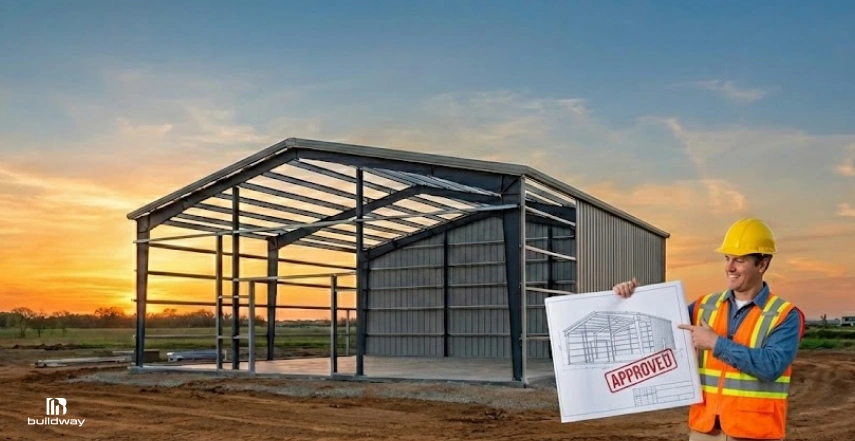
A generic building design won’t cut it. Your supplier must account for your exact location and use-case to ensure safety, compliance, and performance.
What to confirm:
- Live loads: Wind speed, snow load, and seismic conditions
- Exposure category: Open terrain vs urban or coastal
- Importance factor: Varies by use (agriculture, storage, public building, etc.)
Ask for a sample set of engineered drawings with your quote to confirm it’s not “one-size-fits-all” design.
Pro tip: Check if the building is IBC (International Building Code) compliant and ask which version is being used.
Red Flag: Supplier can’t name your local code or won’t confirm it’s been engineered for your site.
3. What’s Included in the Quoted Price and What’s Not?
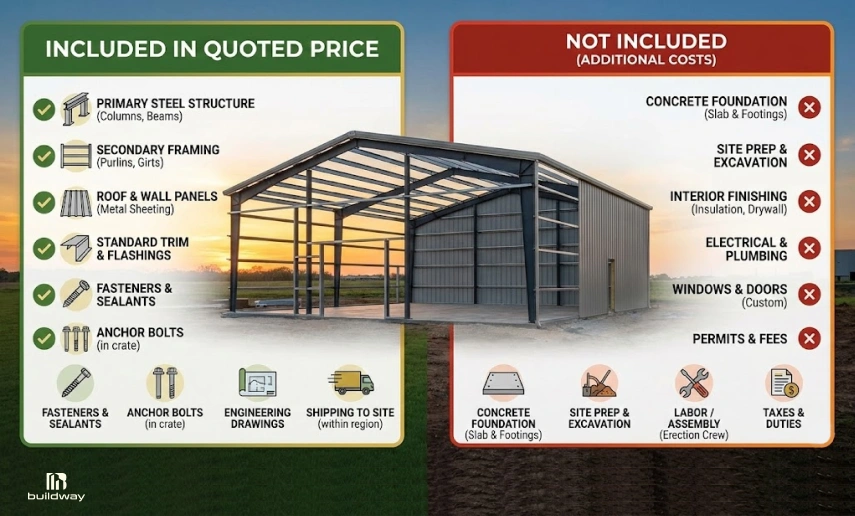
This is where many buyers get burned. Quotes can be intentionally vague, hiding exclusions that later appear as expensive change orders.
Ask to see a line-item scope sheet with:
- Freight and delivery
- Unloading responsibility
- Doors, insulation, trims, fasteners, anchor bolts
- Erection drawings and hardware
- Any upgrade costs (e.g., color, panel type, etc.)
Pro tip: Ask what’s NOT included. Honest suppliers will tell you. Shady ones won’t.
Red Flag: The quote is a single lump sum with no breakdown.
Foundation-related costs are one of the most common (and expensive) exclusions in metal building quotes. If you’re not careful, you could be left footing the bill for concrete work you thought was included. Read this guide on costly foundation mistakes to make sure your site prep and slab decisions don’t blow up your budget.
4. What Gauge Steel and Protective Coating Are You Using?
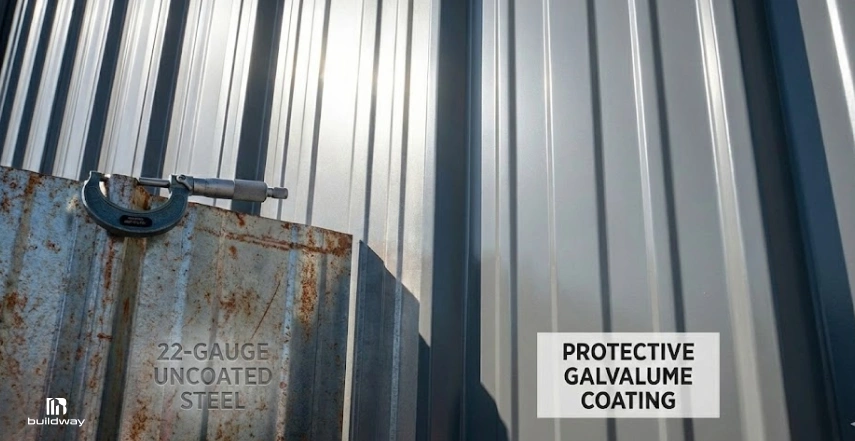
Not all steel is equal. And not all coatings offer the same level of protection.
Ask for:
- Primary frame steel gauge (usually 26, 24, or heavier)
- Secondary framing gauge (girts, purlins)
- Coating type: Galvalume® vs Galvanized
- Paint system warranty (25–40 years is standard)
Pro tip: For roof panels, Galvalume® typically offers better corrosion resistance than galvanized, especially in open or coastal environments.
Red Flag: Supplier doesn’t specify steel thickness or coating in writing.
Not all steel is created equal and some suppliers use misleading terms to make their buildings sound stronger than they really are. Discover the biggest myth about steel building durability and how to see through the marketing noise when comparing specs.
5. What Is the Lead Time And Can You Guarantee It?
Your construction schedule depends on the building showing up when promised. And that’s rarely as soon as the sales team says.
Ask about:
- Fabrication time vs actual delivery time
- Whether lead times are guaranteed in writing
- How change orders or permitting delays may impact the schedule
Pro tip: Some suppliers offer “fast-track” shipping, but ask what’s sacrificed (quality, customization, etc.).
Red Flag: Vague answers like “probably 6–8 weeks” or “we’ll get back to you.”
6. Who Handles Permits and Sealed Drawings?
Permitting is a common source of delay and confusion.
Ask:
- Will I receive sealed engineering drawings for submission?
- Who pays for plan revisions if the city rejects the initial submission?
- How long does it typically take to get permit-ready plans?
Pro tip: Some cities require structural calcs, site-specific engineering, or special inspections. Make sure your supplier is familiar with local requirements.
Red Flag: The supplier tells you to “figure it out with your local city.”
7. What Warranties Are Offered And Who Backs Them?
Warranties can be structural, finish-based, or weathertightness-related and not all are created equal.
Ask to see:
- A sample structural warranty
- The paint system warranty (and what voids it)
- Any limitations on weathertightness guarantees
Pro tip: A manufacturer-backed warranty is far more trustworthy than one from a reseller or broker.
Red Flag: “Lifetime warranty” without clear terms and conditions.
8. Can You Provide References for Recent Similar Projects?
Anyone can show you nice photos but talking to real customers reveals the truth.
Ask for:
- 2–3 references from recent projects similar to yours
- Contact info and permission to ask detailed questions
Ask those references:
- Were there delays or unexpected costs?
- How was communication during the project?
- Would they work with this supplier again?
Red Flag: Supplier hesitates to share references or only gives vague testimonials.
9. How Do You Handle Change Orders and Cost Overruns?
Even the best-planned project may need adjustments. The key is how those changes are managed.
Clarify:
- How are change requests submitted?
- Who approves them and how quickly?
- How is cost impact documented and communicated?
Pro tip: Good suppliers use change order logs with signatures and price impacts clearly documented.
Red Flag: No formal change order process or documentation.
10. What Kind of Support Will I Get After Delivery?
Your relationship with the supplier shouldn’t end at delivery. Post-sale support matters.
Ask:
- Is there support for erection-related questions (RFIs)?
- How are missing or damaged parts handled?
- What’s the process for ordering replacement parts later?
Pro tip: Make sure you receive a complete part list and instructions with your delivery.
Red Flag: Supplier disappears after the sale or redirects you to another company for support.
Quick Red Flags Checklist
Use this at any point during your supplier evaluation.
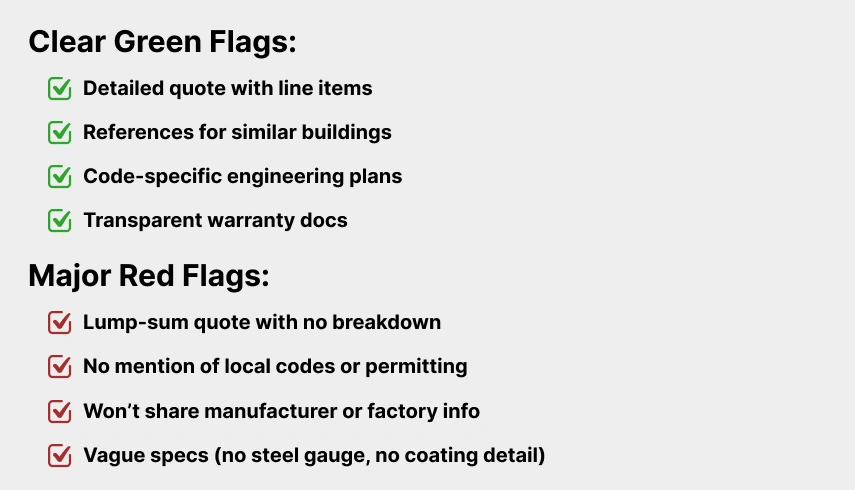
Clear Green Flags:
- Detailed quote with line items
- References for similar buildings
- Code-specific engineering plans
- Transparent warranty docs
Major Red Flags:
- Lump-sum quote with no breakdown
- No mention of local codes or permitting
- Won’t share manufacturer or factory info
- Vague specs (no steel gauge, no coating detail)
Final Tip: Get It All in Writing
This cannot be overstated: never rely on verbal promises when it comes to a major capital purchase like a metal building. Make sure your contract includes:
- A complete scope of materials
- Engineering specifications by location
- Lead times with shipping terms
- Detailed warranty documentation
- Change order policy
If it’s not in writing. It doesn’t exist.
Choose a Supplier Who Puts Clarity and Trust First
Purchasing a metal building is a high-stakes decision and the supplier you choose can make or break your project. From engineering accuracy and code compliance to lead times and long-term support, every detail matters. That’s why knowing the key questions to ask a metal building supplier before signing is critical.
At Buildway, we believe informed buyers make better decisions and better projects. We’re not just here to sell you a building; we’re here to guide you through the process with complete transparency. Every quote we provide includes:
- A detailed, line-by-line scope of what’s included (and what’s not)
- Site-specific engineering tailored to your location and code requirements
- Clear warranty documentation backed by trusted manufacturers
- Reliable lead times, with realistic delivery expectations
- Honest, pressure-free support from first call to final delivery
If you’re comparing suppliers or still gathering information, let us help. We’ll review your project needs, walk you through a clear quote, and help you with all the questions to ask a metal building supplier, before you sign anything. Give us a call now or request a direct quote.
FAQ: Metal Building Supplier Questions
1. Do all metal building suppliers include engineering in the price?
No. Some suppliers include site-specific engineered drawings in their base price, while others charge extra or only provide generic plans. Always confirm that sealed, code-compliant drawings for your location are included before signing.
2. What’s better: Galvanized or Galvalume® steel for metal buildings?
Galvalume® is generally the better option for roofing, offering superior corrosion resistance especially in coastal, humid, or high-moisture environments. Galvanized steel performs well in dry settings but may degrade faster in marine conditions.
3. How do I compare metal building quotes from different suppliers?
Use a line-item quote comparison checklist. Focus on what’s included, what’s excluded, freight and unloading responsibilities, engineering, and warranties. Avoid comparing based on lump-sum prices alone. Scope and specifications can vary significantly.
4. What’s the difference between metal building brokers and manufacturers?
Manufacturers design and fabricate the building components in-house. Brokers act as intermediaries, selling buildings from various manufacturers. Always ask who is providing the engineering, warranties, and post-sale support.
5. Can I make changes to my building after signing the contract?
Yes, but changes typically require a formal change order process. Depending on the supplier, changes may lead to added costs, revised lead times, and updated engineering. Ask about the process and potential fees before finalizing your contract.
6. Do all metal buildings meet local building codes?
Not by default. Some suppliers only offer generic designs unless you specifically request site-specific engineering. Always confirm that your building will meet your location’s wind, snow, seismic, and exposure requirements per the International Building Code (IBC).
7. What warranties should I expect with a metal building?
Most reputable suppliers offer warranties for:
- Structural frame integrity (typically 20–50 years)
- Paint or panel finish (25–40 years)
- Weathertightness, though this is often conditional
Make sure the warranties are backed by the manufacturer, not just the dealer or broker.
8. How long does it take to receive a metal building after ordering?
Lead times can range from 4 to 12+ weeks, depending on the supplier, building complexity, and seasonal demand. Always ask for a realistic fabrication and delivery schedule, and whether the timeline is contractually guaranteed.
9. Who is responsible for permits and local inspections?
In most cases, you as the buyer are responsible for securing permits. However, a reputable supplier should provide sealed engineering drawings to help with submittals. Ask how many revisions are included if your local building department requires changes.
10. What support do I get after the building is delivered?
This varies by supplier. Quality vendors offer:
- Help with RFIs during construction
- Access to replacement parts
- Technical support for erection issues
Ask about available support channels and response times before committing.
11. What are the most important questions to ask a metal building supplier?
When evaluating suppliers, ask about engineering specifics, local code compliance, delivery timelines, warranty details, and what’s included in the quoted price. These questions protect your project from unexpected delays or hidden costs.